Google Ad Grants Landing Pages: The Website Policy and Pages That Convert
By Mike Krieg · Updated October 23, 2026
Google Ad Grants ads must point to a website your nonprofit owns, served entirely over HTTPS, with substantial original content and a clearly stated mission. Within that site, send each ad group to the one page that answers its searches, and give that page a single clear sign-up so the visit can become a conversion.
This guide covers Google's website policy, how to choose a landing page per ad group, and what makes a page convert, with the choices Storyline made for its Spanish campaign. Ad copy is in writing Ad Grants ads; counting the conversion is in conversion tracking with GA4.
Google's website policy, point by point
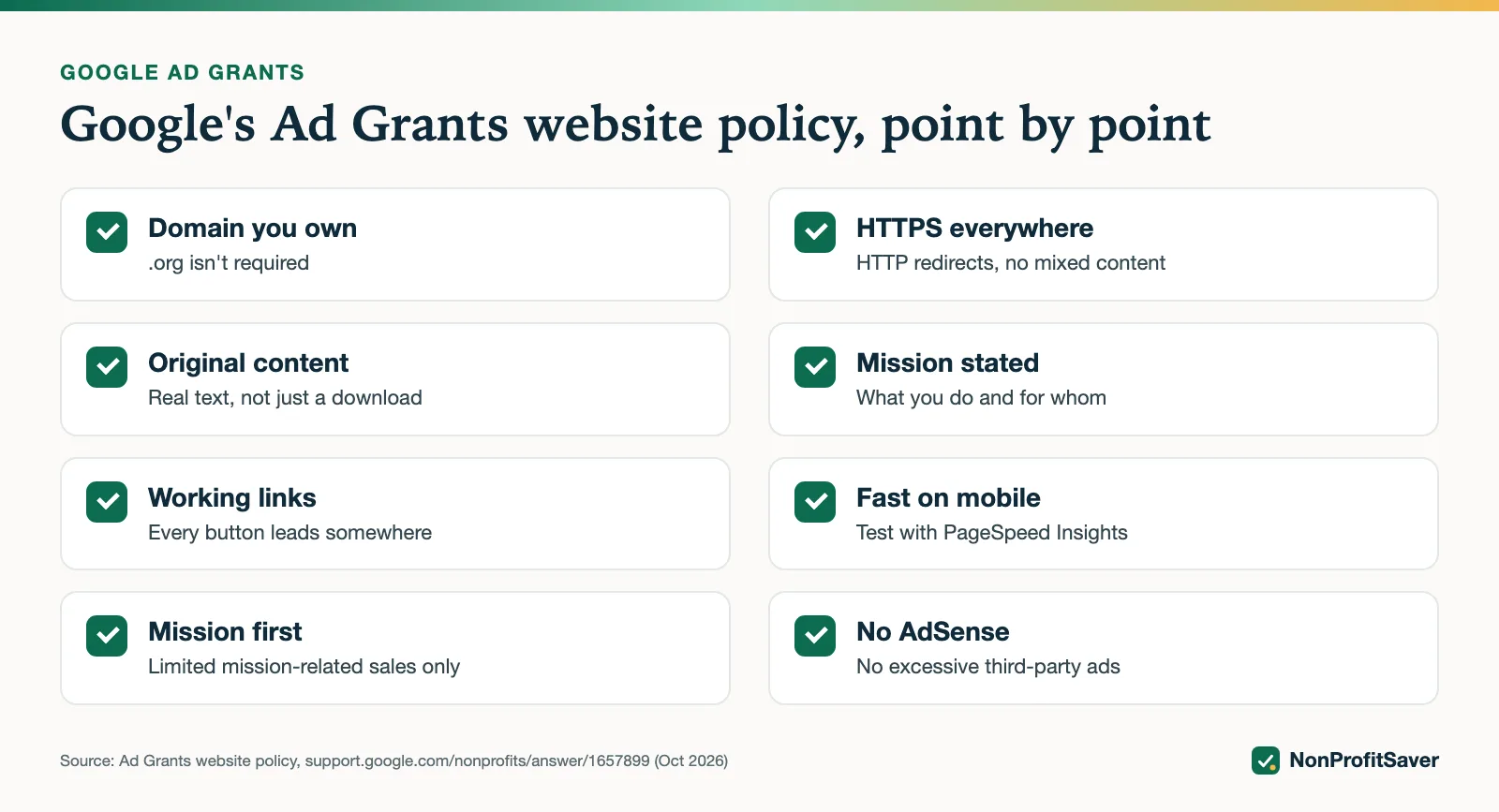
Google's Ad Grants website policy sets these requirements, as of October 2026 (the page shows no last-updated date):
| Requirement | What Google says | How to check |
|---|---|---|
| Domain ownership | "Your nonprofit must own the domain(s) your ads point to." .org isn't required. | The domain is registered to your organization |
| HTTPS | "Your entire website must be served over HTTPS", with HTTP redirected and no mixed content | Open a few pages with http:// and confirm they redirect |
| Original content | "Your site must have a significant amount of original content." Thin, copied, placeholder or PDF-dependent content is a pitfall | Each advertised page has real text, not just a download |
| Mission | The site must "clearly state your nonprofit's mission and describe its activities or services". Google recommends showing your address and EIN or an annual report | About page and footer |
| Navigation | "All links should work correctly", and donation buttons must lead to working pages | Click every button on advertised pages |
| Speed | Pages "should load quickly"; Google suggests PageSpeed Insights | Test each landing page, on mobile |
| Mobile | The site "must display and function correctly on smartphones and tablets" | Open each page on a phone |
| Commercial activity | The site should focus on the mission; limited mission-related sales may be fine if you explain how proceeds support programs | Product pages say where the money goes |
| Third-party ads | "Your site cannot host excessive third-party ads (e.g., Google AdSense)", and Google's action item is not to display AdSense | Remove ad units from advertised pages |
The program also applies to whole accounts: Google's mission-based campaigns policy says every ad and keyword must reflect your primary mission. A page selling unrelated products fails even if the site passes.
Why the page affects your grant
The landing page isn't only a policy matter. Quality Score, which Ad Grants requires to stay at 3 or above, includes "landing page experience" as one of its three parts (Google's Quality Score page). Google's compliance guide adds that a below-average landing page experience "indicates that users weren't finding the content that they were looking for", and treats it as a sign the keyword is too generic.
So a weak page lowers Quality Score, pulls down click-through rate and gives Smart bidding no conversions to learn from. All three are rules that can pause the account.
Choosing a landing page for each ad group
One ad group, one question, one page. A simple method:
- List your ad groups and the question each one answers.
- For each, find the page on your site that answers that question best. If none does, that's a page to write, not an ad group to build yet.
- Check the page against the table above.
- Check it has a next step (see below). If it doesn't, add one before advertising it.
| Search | Weak landing page | Strong landing page |
|---|---|---|
| how to start a food pantry | Homepage | A guide to starting a food pantry, with a sign-up for the starter checklist |
| volunteer opportunities [your city] | Generic "Get involved" page | The volunteer sign-up page for that city |
| grief support group near me | Events calendar | The grief group page with times and a registration form |
A real example: why SENT (ES) doesn't land on the app
Storyline, the nonprofit that runs alongside NonProfitSaver, posted the Spanish campaign SENT (ES) on 23 October 2026 to promote SENT, its free evangelism training app at sent.storylinemissions.org. You might expect the ads to land on the app's site. They don't. Its four ad groups land on four Spanish articles on Storyline's main site instead:
| Ad group | Lands on |
|---|---|
| Cómo evangelizar | Gospel conversation starters (Spanish) |
| Guiar a alguien a Cristo | How to lead someone to Christ (Spanish) |
| Campo misionero | Find your mission field (Spanish) |
| Plan supremo de evangelización | The Master Plan of Evangelism (Spanish) |
Two reasons, both from Storyline's own planning notes:
- The app site had no analytics, so a sign-up there couldn't be counted as a conversion, and an Ad Grants campaign without conversions stalls.
- The app's text is drawn by JavaScript, so to Google the page looks almost empty: a poor fit for a policy that asks for "a significant amount of original content".
The articles answer the search directly. The plan is for each to link into SENT and carry a sign-up box that starts an email series; where one didn't yet, it went on the fix list. One sitelink ("Prueba SENT Gratis") still goes to the app site for people who want it straight away.
Storyline also left one article out. Its Spanish personal testimony page had no SENT link, no sign-up box and was set to noindex, so it wasn't advertised until fixed. Not every relevant page is ready to be a landing page. Some of the four articles were also still waiting on small fixes (a missing SENT link on one, page descriptions on others) when the campaign went live. We say so because it's typical: pages are rarely perfect on launch day, and the fix list is part of the work.
We don't have conversion results for these pages yet and won't guess at them.
Making the page convert
A conversion has to mean something. Google's program policies list donations, volunteer sign-ups and email sign-ups as examples, and say time on site and homepage visits belong in the "Other" category. The compliance guide adds that your conversion page shouldn't be "a frequently visited, common page".
What helps a page earn that conversion:
- One action, matching the ad. If the ad promises a free checklist, the page offers the checklist. Don't make visitors choose between five buttons.
- Visible early and again at the end. A sign-up near the top for people ready now, and one after the content for people who read first.
- Short forms. Ask for what you'll use. A first name and email is enough for a resource sign-up.
- A countable finish. A thank-you page or a form event that fires once per sign-up, so Google Ads counts it. Test it with your own sign-up.
- Works on a phone. Google's website policy requires it; fill in your own form on one.
- Trust signals. Your organization's name, mission and contact details, which Google's website policy asks for anyway.
A pre-launch checklist for each landing page
- On your own domain, HTTPS, no mixed content
- Answers the ad group's question in the first screen
- Real original text, not only a PDF or video
- One clear sign-up, registration or donation, tested on a phone
- Conversion counted once per sign-up, tested
- No AdSense or other third-party ads
- Loads quickly in PageSpeed Insights
With or without the kit
Everything above is a manual check you can do in an hour. Our Google Ad Grants Kit ($97 once, early access; sales haven't opened yet) includes a compliance checklist (own domain, https, real content, a tested conversion, one landing page per ad group) and a campaign builder that requires a full https address for every ad group's landing page. It can't judge your content for you; that part is yours either way. Plain about our interest: it's our paid product. If your account is live but barely showing, start with why a new Ad Grants account barely shows.
Frequently asked questions
What are the website requirements for Google Ad Grants?
Your nonprofit must own the domain, the whole site must use HTTPS, and it needs substantial original content, a clear mission, working links and donation pages, fast mobile-friendly pages and no excessive third-party ads such as AdSense.
Can Ad Grants ads point to my homepage?
They can, but they usually shouldn't. Each ad group should land on the page that answers its searches. A homepage rarely answers a specific question, which hurts click-through rate and Quality Score.
What makes an Ad Grants landing page convert?
One clear action that matches the ad, such as a sign-up or registration, visible without hunting, and a thank-you page or form event so the conversion is counted.
Related guides
- Google Ad Grants for Nonprofits: How It Works, the Rules and the Catch
- Google Ad Grants for Churches: Who Qualifies and What Paperwork Works
- How to Apply for Google Ad Grants, Step by Step
- Google Ad Grants Requirements: The Compliance Checklist
This guide is general information, not legal, tax, or financial advice. Prices change; see each linked source. Report a correction.