Google Ad Grants for Churches: Who Qualifies and What Paperwork Works
By Mike Krieg · Updated October 23, 2026
A church can get Google Ad Grants if Google can verify its tax-exempt status. Google's US requirements, as of October 2026, ask for IRS 501(c)(3) registration or a group exemption with proven affiliation to a 501(c)(3) central organization, verified by Goodstack (Google for Nonprofits eligibility). Google's US tax-exempt page names churches directly: it notes they are tax-exempt automatically under IRS rules, then says that to be eligible for Google for Nonprofits, organizations "must obtain recognition of 501(c)(3) tax-exempt status from the IRS", and that organizations not listed in the IRS's online publication "aren't eligible". Churches covered by a group exemption "may still be eligible". So the obstacle is paperwork, and for a church that never applied it is a real barrier.
This guide covers the verification problem, what Google does and doesn't say about religious organizations, and how a church can use the grant well. It's general information, not legal or tax advice.
The paperwork problem
Under IRS rules, churches that meet the 501(c)(3) requirements are tax-exempt automatically; they don't have to apply. But Google's verification partner checks status against records, and a church that never applied for an IRS determination letter usually isn't in those records. So a church can be fully exempt and still fail verification.
The IRS says this itself. Its Tax Guide for Churches and Religious Organizations (Publication 1828, checked October 2026) states that churches meeting the 501(c)(3) requirements "are automatically considered tax exempt and are not required to apply". The same guide explains that the IRS's public search tool, Select Check, doesn't include churches that have not applied for recognition, and that "only the parent organization in a group ruling is included by name." Google's Goodstack verification page says Goodstack checks organizations against official government registries. Put those together and you have the problem: a church that never applied, or a congregation listed only under its denomination's group ruling, may not show up where the check looks. What Google's pages don't say is exactly which registries Goodstack uses for US churches.
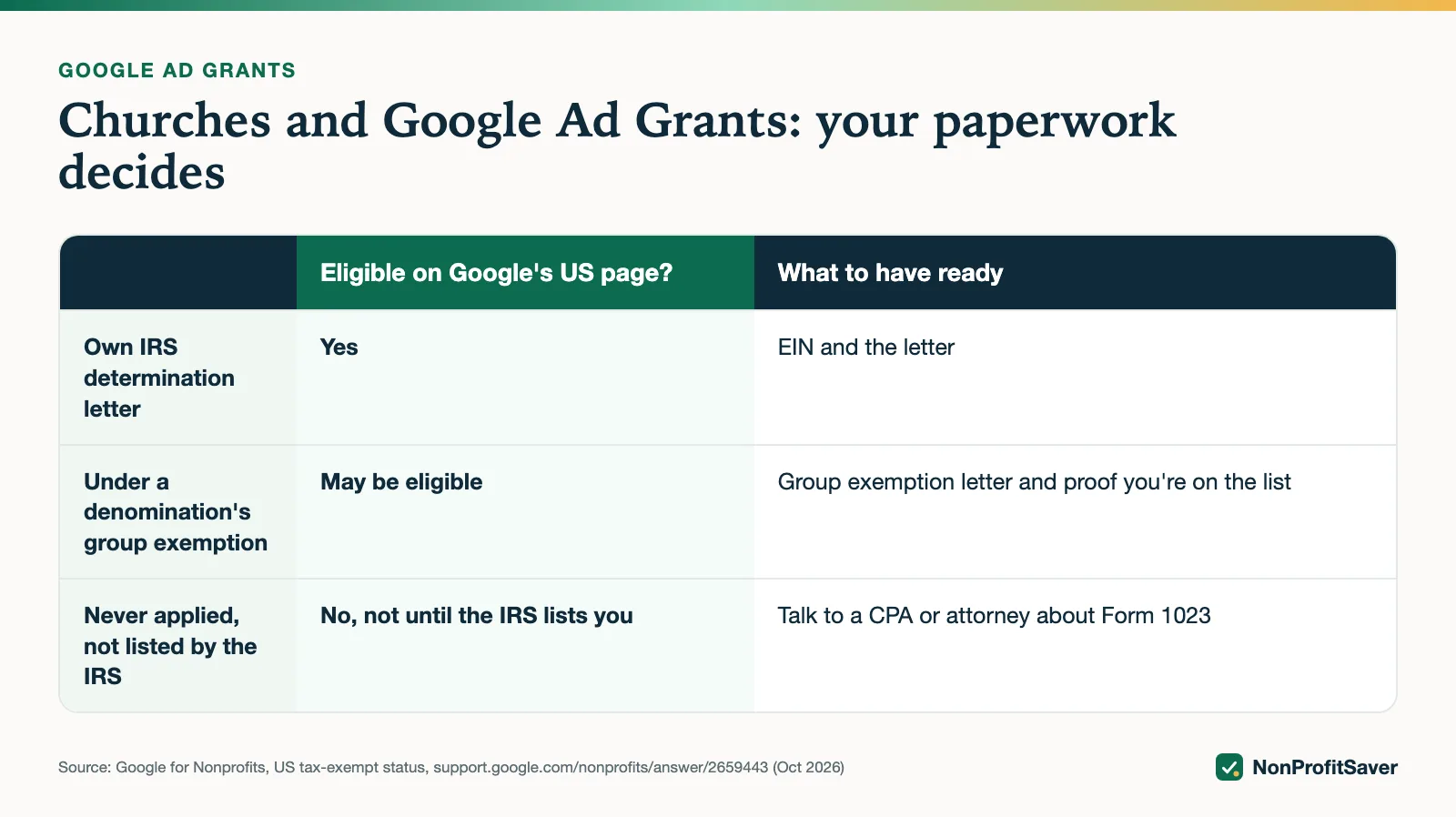
Three situations:
- Your church has its own IRS determination letter. You're in the strongest position. Apply through Google for Nonprofits with your EIN.
- Your church is covered by your denomination's group ruling. Google accepts group-exempt organizations with proven affiliation to a 501(c)(3) central organization. Get a copy of the group exemption letter and confirmation that your church is on the central organization's subordinate listing.
- Your church is independent and never applied. On Google's current US page you aren't eligible until the IRS lists you. The route is, with professional advice, to apply for recognition on IRS Form 1023 (churches applying voluntarily still pay the IRS user fee). Our guide on church eligibility for nonprofit discounts covers this in more detail.
If Goodstack can't verify you automatically, Google says it will email you (from verifications@mail.goodstack.org) asking for documents such as founding bylaws, registration certificates or a tax exemption determination letter, and that a refusal can be appealed through Goodstack's appeal form. For a group-exempt church, the strongest packet is the denomination's group exemption letter plus written confirmation from the central organization that your church is on its list.
On the Form 1023 route: as of October 2026 the IRS user fee for Form 1023 is $600. Weigh that against what the grant is worth to you, and ask a CPA or attorney whether recognition makes sense for your church for other reasons too; Publication 1828 notes many churches seek it because it assures leaders, members and contributors of their status.
What Google says about religious organizations
Google's eligibility page lists three excluded types: government entities, hospitals and healthcare organizations, and schools or universities. Religious organizations aren't on that list. Churches are mentioned on Google's US tax-exempt page, and only on the paperwork question above.
Older news coverage reported that Google once excluded churches and organizations with proselytizing content from its nonprofit program. We couldn't find that restriction on Google's current eligibility or Ad Grants policy pages in October 2026, and several agencies report working with church grant accounts today. We can't confirm how Google applies its terms in every case, so treat the current Google pages as the authority and contact Google for Nonprofits support if your situation is unclear.
First-hand: Storyline, a Christian mission-mobilization nonprofit that runs alongside NonProfitSaver, holds an active Ad Grants account. That shows a religious 501(c)(3) can hold one; it doesn't prove every church will be approved.
Storyline's account was created in December 2017, and on 23 October 2026 it posted a Spanish-language campaign for SENT, its evangelism and discipleship material: 4 ad groups, 38 keywords, 29 negative keywords, 8 ads and 4 sitelinks. We share the shape, not results, because there aren't any yet.
What a church can advertise well
The grant rewards pages that answer what people search for. For a church, that usually isn't the church's name; few people search for a church they don't know. Better:
- Questions your teaching already answers. Grief, marriage, anxiety, prayer, reading the Bible. A sermon page or article that answers the question, with a clear next step.
- Local needs. Food pantry hours, recovery groups, ESL classes, after-school programs, in your city.
- Visit pages for people already looking. "Church near me" style searches, landing on a page that tells a newcomer what to expect.
Ad Grants requires at least one meaningful conversion a month, so each page needs something to do: sign up for a class, plan a visit, register, subscribe.
Keywords: where churches trip the rules
Google's mission-based campaigns policy (as of October 2026) bans single-word keywords except your own brand words, recognized medical conditions and acronyms, and it says names of organizations, places or people on their own are too generic. Google's exceptions list allows ten single words, including "donate", "volunteer" and "nonprofit". "Church", "prayer" and "Bible" alone are not on it.
Google's own allowed example is "museums in [your city name]", while a city name alone is not. Google gives no church examples, but by that logic a hypothetical ad group might look like this:
| Ad group | Example keywords | Lands on |
|---|---|---|
| Grief support | grief support group [city], how to cope with grief | Grief group page with a sign-up |
| Food pantry | food pantry [city], free groceries near me | Pantry hours page with a registration form |
| First visit | church in [city], what to expect at church | Plan-a-visit page with a form |
That's two-plus ad groups, each landing on one page with one action, which is what the structure rules ask for. Matching keywords to searches in depth: Ad Grants keywords.
Your giving page
Many churches take gifts through an outside giving platform. Google's website policy says donation links "must work and go to a secure page dedicated to donations", and that your nonprofit must own the domain your ads point to. So point ads at pages on your own site, and make sure the give button leads to a secure donation page. Comparing platforms: church giving platform fees.
Keep the account rules in mind: a 5% click-through rate each month, no single-word keywords like "church" alone, at least 2 ad groups per campaign and 2 sitelinks. The full list: Google Ad Grants requirements.
How to apply
- Gather your EIN and your IRS letter or group exemption documents.
- Join Google for Nonprofits and complete Goodstack verification.
- Activate Ad Grants. Google provides the account; don't create one yourself.
- Set up conversion tracking before your first campaign.
Step by step: how to apply for Google Ad Grants.
If you'd like a guide, checklist and campaign builder for running the account yourself, our Google Ad Grants Kit is $97 once (early access; sales haven't opened yet). You don't need it; Google's Ad Grants help center is free.
Frequently asked questions
Can a church get Google Ad Grants?
Yes, if it has IRS recognition of 501(c)(3) status or is covered by a group exemption. Google's US page names churches: those not registered with the IRS and not listed in its online publication of tax-exempt organizations aren't eligible.
Does my church need an IRS determination letter for Google Ad Grants?
Not legally, but often in practice. Churches are automatically tax-exempt under IRS rules, but Google's verification partner checks IRS records. A denomination's group exemption can work instead, if your church is on its subordinate listing.
Can a church advertise worship services with Ad Grants?
The ads must follow Google's normal ad policies and the Ad Grants rules, including the 5% click-through rate. Google's pages we checked don't publish a separate rule for religious content, so read the current policies before you build.
Related guides
- Google Ad Grants for Nonprofits: How It Works, the Rules and the Catch
- How to Apply for Google Ad Grants, Step by Step
- Google Ad Grants Requirements: The Compliance Checklist
- Ad Grants Conversion Tracking with GA4, Step by Step
This guide is general information, not legal, tax, or financial advice. Prices change; see each linked source. Report a correction.