Facebook Ad Grants for Nonprofits: What Meta Actually Offers in 2026
By Mike Krieg · Updated October 23, 2026
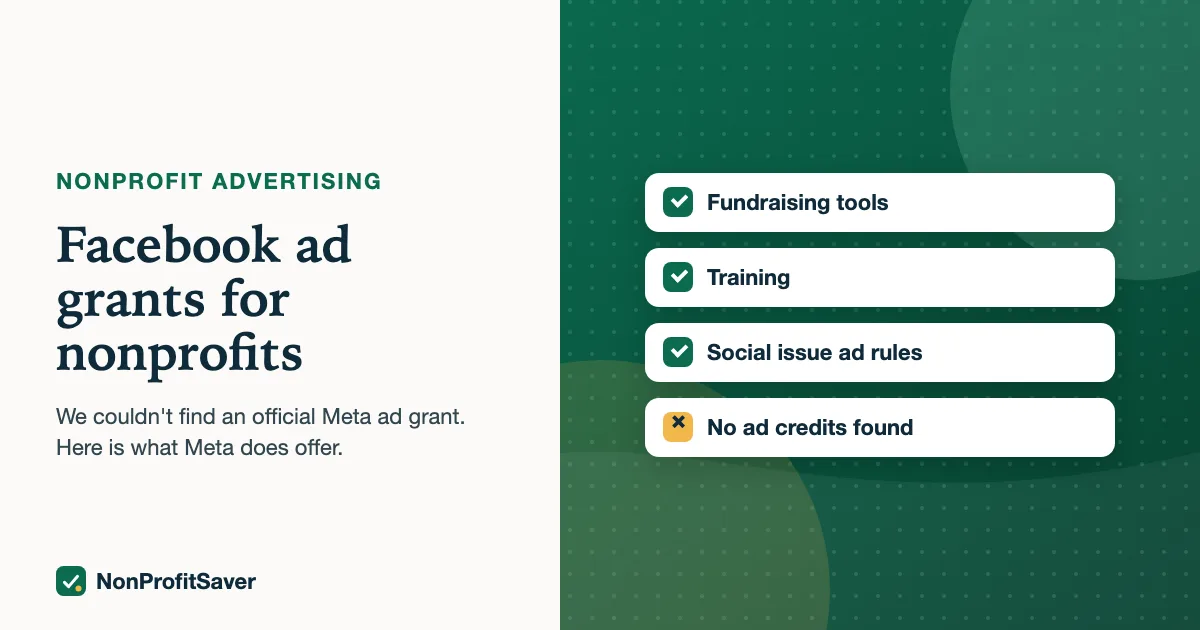
We couldn't find an official Facebook or Meta ad grant program for nonprofits. Meta's own nonprofit hub lists fundraising tools, live support, training and advertising guides, but no free ad credits or grant application, as of October 2026.
That's different from what you may have read. Several marketing blogs describe Meta ad credits for nonprofits, some with dollar amounts attached. None of the ones we checked linked to a Meta page that confirms those amounts, and the figures disagree with each other. So we're not repeating them. If Meta publishes a program, we'll update this guide.
Here's what Meta does offer, the rules that affect nonprofit ads, and how to get the most out of a small budget.
What Meta's official pages offer nonprofits
From Meta's nonprofit hub, as of October 2026:
- Fundraising tools. "If you manage an eligible nonprofit Facebook Page, you can apply for access to Meta fundraising tools." This covers things like donate buttons and fundraisers people run for your cause.
- Meta Support Pro, live help for product and technical questions.
- Guides by goal: raise awareness, fundraise, recruit supporters, including how to "drive action with Meta ads."
- Training: an on-demand video library, events, and Meta's digital marketing certifications, which have a nonprofit learning path.
Every ad you run on Facebook or Instagram is paid, at normal prices. Meta's pages don't mention a nonprofit discount on ads.
Fundraising tools: who can use them
Meta's donation help page says it works exclusively with PayPal Giving Fund for donations, which supports nonprofits in Australia, Canada, the United Kingdom and the United States, as of October 2026. It also says donations are "irrevocable gifts to PPGF", meaning PayPal Giving Fund receives the gift and passes it on.
Two catches. First, if you're outside those four countries, these tools aren't available to you. Second, fees. Older articles say Facebook covered all processing fees. Several 2023 and 2024 nonprofit and vendor articles say that changed when donations moved to PayPal Giving Fund, but we couldn't find Meta's current fee terms on its own pages. Check PayPal Giving Fund's terms for your country before you count on receiving 100% of a donation.
The rule most nonprofits trip on: social issue ads
Meta's policy on ads about social issues, elections or politics applies to any ad that "Is about any social issue in any place where the ad is being run", as of October 2026. Advertisers located in or targeting people in Meta's designated countries must complete its authorization process and add a verified "Paid for by" disclaimer. Ads without one can be disapproved. Meta's 2026 midterm plans (below) show these rules are in force in the US.
Many nonprofits work on topics that can count as social issues. Meta keeps the full definition on a separate help page, and it decides case by case. A food pantry ad that just lists hours is probably fine. An ad urging people to act on a public issue may not be. Read the definition before you build the campaign, and allow time for identity verification.
One date to know this year: Meta said in February 2026 that it "will block new political, electoral, and social issue ads during the final week of the US election campaign" before the November midterms. Ads that had at least one impression before the restriction period can keep running. If you planned a social issue ad for early November 2026, launch it before that week or plan around it.
Watch out for "free Facebook ad credit" offers
Search results for Facebook ad credits include agencies, coupon sites and sellers of "credit" that isn't from Meta. Some may be genuine promotions shown inside an advertiser's own Ads Manager, but we couldn't find a Meta page describing credits for nonprofits. A few plain rules:
- Real Meta promotions show up in your own Ads Manager or come from Meta, not from a stranger asking for access to your account.
- Never give an agency admin access to your Page or ad account just to receive "credits". Give partner access through your own business settings, and remove it when the work ends.
- If an offer requires you to buy something first, it's a discount, not a grant. Do the arithmetic before you agree.
How to stretch a small Meta budget
Without a grant, the question becomes how to spend a little well. We haven't published Storyline's Meta ad results, so this is method, not a promise of numbers.
1. Start with one clear action. A newsletter sign-up, event registration or donation page. Awareness campaigns are hard to measure on a small budget.
2. Install the Meta pixel or conversions setup first. Without it, Meta can't tell which ads led to sign-ups or gifts, and you can't either.
3. Boost what already worked. A post that did well organically is a cheaper test than a new ad. Run it to a defined audience with a small daily budget and an end date.
4. Retarget your own visitors. People who already visited your site are more likely to act than strangers. A small retargeting campaign is often the most efficient use of a little money.
5. Use the free search channel first. If you're a US 501(c)(3), Google Ad Grants still offers eligible nonprofits up to $10,000 a month in Google Search text ads, as of October 2026, per Google's Ad Grants page. It has strict rules, and Google calls the $10,000 "a limit, not a guarantee of spend", but it costs nothing. Search ads catch people already looking; Meta ads interrupt people scrolling. Many nonprofits use both: the grant for intent, a small Meta budget for reach.
Google Ad Grants vs Meta ads, side by side
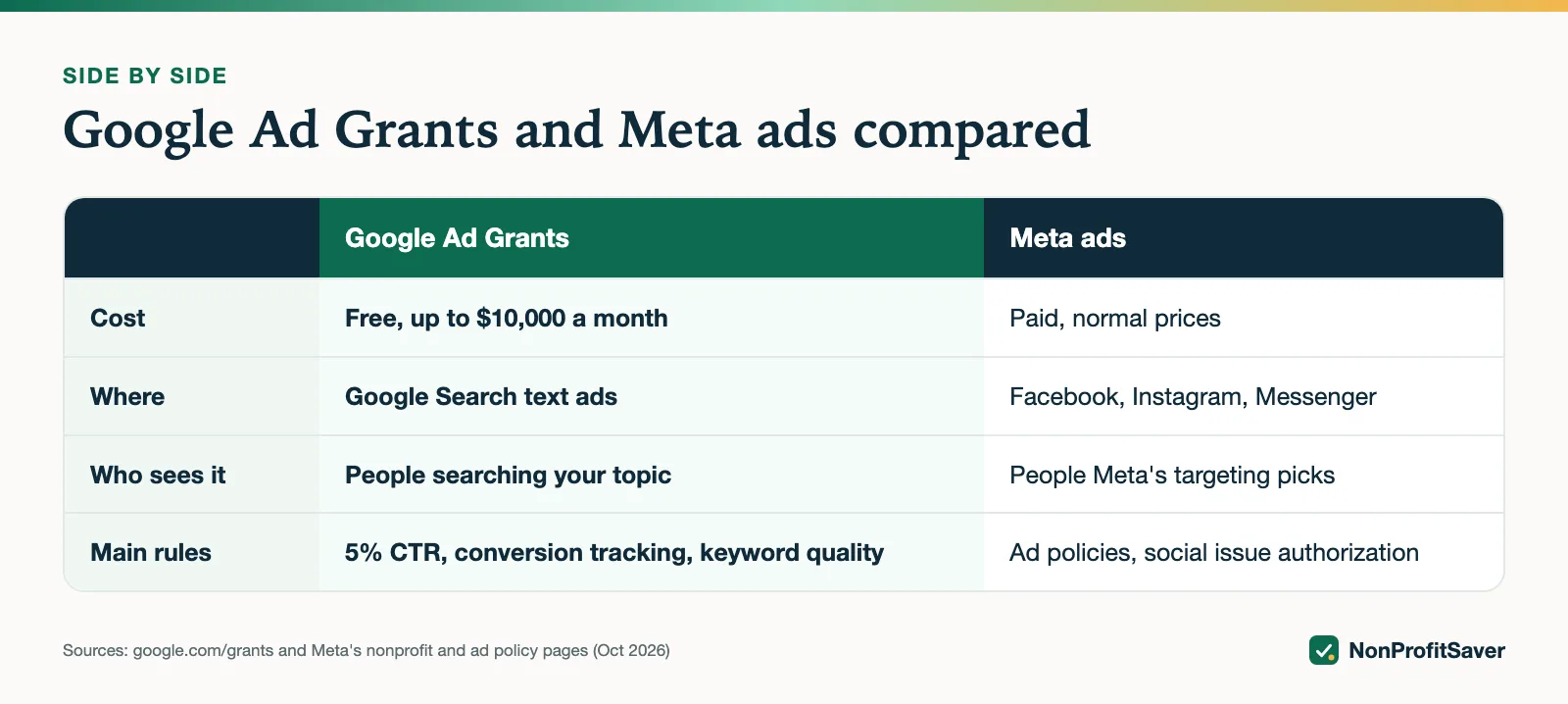
| Google Ad Grants | Meta ads | |
|---|---|---|
| Cost | Free, up to $10,000 a month | Paid, normal prices |
| Where | Google Search text ads | Facebook, Instagram, Messenger |
| Who sees it | People searching your topic | People Meta's targeting picks |
| Main rules | 5% CTR, conversion tracking, keyword quality | Ad policies, social issue authorization |
| Weekly time | About 15 minutes once built | Depends on how many ads you run |
Before you apply for the grant, check Ad Grants eligibility and the requirements that keep it.
Our interest, plainly
NonProfitSaver makes the Google Ad Grants Kit ($97 once, early access; sales haven't opened yet), and it covers Google Ad Grants only, not Meta. You don't need it for anything in this guide. No vendor pays to be mentioned here (methodology). For every other free or discounted ad program we could verify, see free advertising for nonprofits.
Frequently asked questions
Does Facebook give ad grants to nonprofits?
We couldn't find one. Meta's official nonprofit pages list fundraising tools, training and support, but no standing ad grant or ad credit program, as of October 2026.
Can nonprofits get free Facebook ad credits?
Not through any public application we could find on Meta's pages. Some blogs quote credit amounts; we couldn't confirm them, so treat any offer that asks for payment or login details with caution.
Do nonprofit ads on Facebook need special approval?
Ads about social issues, elections or politics need Meta's authorization and a "Paid for by" disclaimer. Many nonprofit topics can fall into that category, so check before you run.
Related guides
- Free Advertising for Nonprofits: Every Ad Grant Program We Could Verify
- Microsoft Ad Grants for Nonprofits: What Happened, and What to Do Instead
- YouTube Ad Grants: What Exists, What Doesn't, and What to Use Instead
- LinkedIn Ad Grants for Nonprofits: Rounds, Rules and the Discount That Isn't for Ads
This guide is general information, not legal, tax, or financial advice. Prices change; see each linked source. Report a correction.